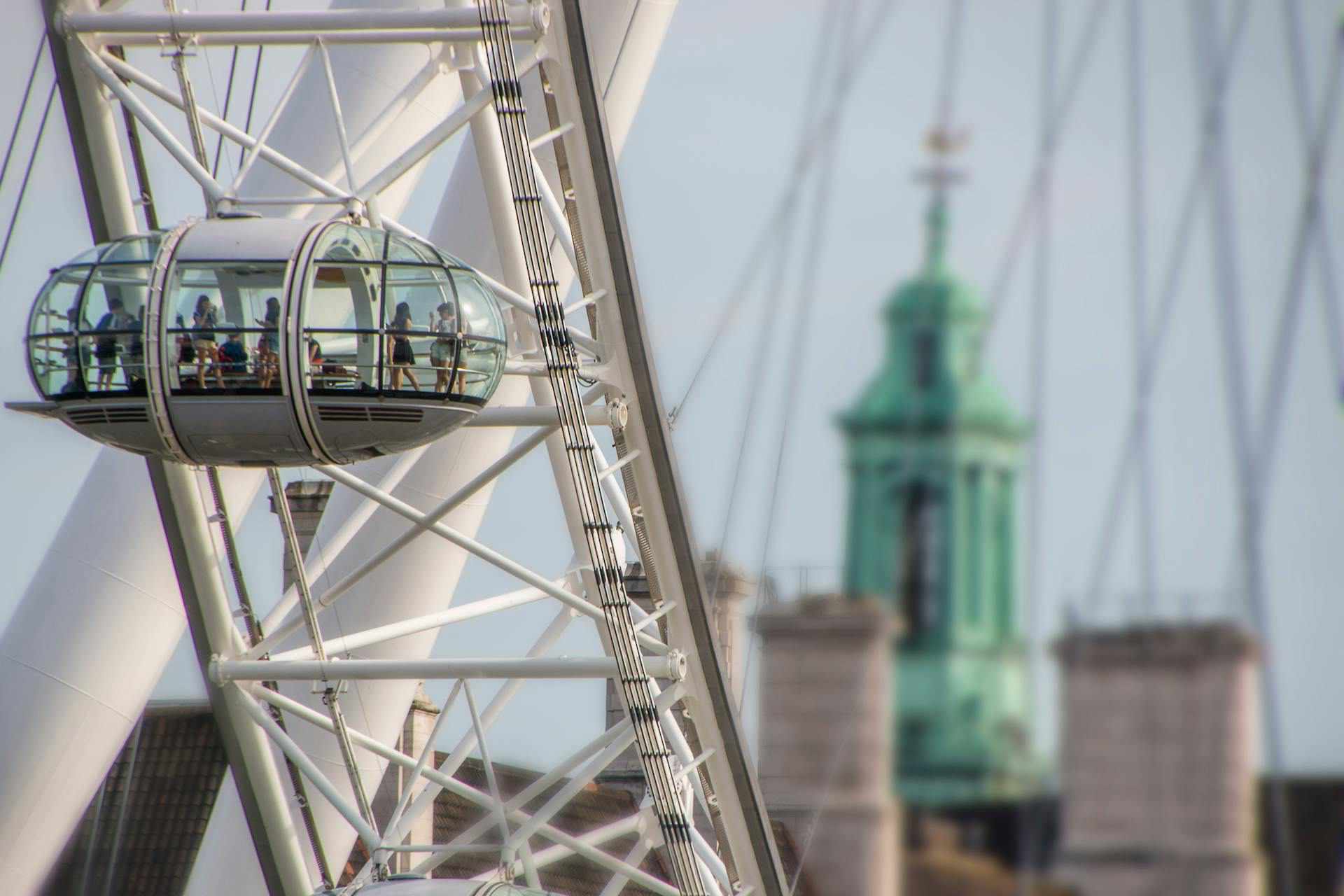
The London Eye, or the Millennium Wheel, located on the South Bank of the River Thames, is one of London’s most iconic landmarks that is visited by millions of people every year.
The cantilevered observation wheel opened in 1998 and was originally intended as a temporary attraction, with a five-year lease. In December 2001, operators submitted an application to Lambeth Council to give the London Eye permanent status, and the application was granted in July 2002.
The wheel has 32 sealed and air-conditioned ovoidal passenger capsules. Each capsule represents a London Borough and holds up to 25 people, who are free to walk around inside the capsule, though seating is provided.
The wheel rotates 0.6 mph per second (about 0.9 km) so that one revolution takes about 30 minutes, giving a theoretical capacity of 1,600 passengers per hour.
It does not usually stop to take on passengers; the rotation rate is slow enough to allow passengers to walk on and off the moving capsules at ground level. It is stopped, however, to allow disabled or elderly passengers time to embark and disembark safely.
The New Year’s Eve fireworks in London are launched from the London Eye each year. This iconic observation wheel serves as the centrepiece for the city’s annual pyrotechnic display, creating a dazzling spectacle that lights up the night sky over the River Thames as Londoners and visitors welcome the new year.

London Eye Opening Times
The London Eye is open daily from 10 am to 8:30 pm. For a quieter experience, it is recommended you visit early in the morning or later towards closing time. The time stated on your ticket is when you enter the queue line.
During busy peak periods like weekends and school holidays, expect longer wait times for London Eye boarding. During peak times, the wait can be up to 45 minutes.
You can reduce your queuing time by upgrading to Fast Track entry.
London Eye Prices
London Eye tickets start from £29 per adult and £26 for children up to 15.
It is best to book in advance and try to avoid booking during busy periods as ticket prices increased quite substantially.
For more information on tickets and times, visit the London Eye website for more information.
How To Get To The London Eye
The London Eye is located on the South Bank of the River Thames. The nearest underground and train stations are Waterloo and Westminster.
From Waterloo Station, it is an 8-minute walk, for directions click here.
From Westminster Station, it is also roughly an 8-minute walk. When exiting the station, turn left and walk towards Westminster Bridge. You will instantly see the wheel. For directions click here.
Buses to the London Eye include the 211, 77 and 381.

Nearby Attractions
The London Eye is situated in the heart of London and is surrounded by numerous other splendid attractions that are within walking distance.
Big Ben
Just across the river, opposite the London Eye, stands another of London’s most famous landmarks: Big Ben and the Houses of Parliament. It’s a five-minute walk across Westminster Bridge, and no directions are needed.
Westminster Abbey
Westminster Abbey, located across the road from the Houses of Parliament, is a magnificent Gothic church with over a thousand years of British history. This UNESCO World Heritage site has been the coronation church since 1066 and the final resting place of seventeen monarchs. Its awe-inspiring architecture features soaring vaulted ceilings, intricate stone carvings, and stunning stained-glass windows.
Buckingham Palace
Buckingham Palace, the official London residence of the British monarch, is an iconic symbol of the British Royal Family and a must-see landmark for visitors to the capital. This grand neo-classical building, with its distinctive cream and gold facade, stands majestically at the end of The Mall in Westminster.
St James’s Park
St James’s Park, the oldest of London’s royal parks, is a tranquil oasis nestled in the heart of Westminster. This 57-acre green space offers a welcome respite from the bustling city, with its lush lawns, flowerbeds, and tree-lined paths.
The park’s centrepiece is a picturesque lake, home to a variety of waterfowl, including the park’s famous pelicans—a tradition dating back to the 17th century when the birds were gifted to Charles II. Visitors can enjoy charming views of Buckingham Palace from the Blue Bridge, which spans the lake.
Sea Life
The Sea Life London Aquarium is situated on the ground floor of County Hall on the South Bank of the River Thames, merely a minute’s walk from the London Eye. Sea Life aquariums are fantastic family attractions, boasting stunning marine habitats and displays.
The London Dungeon
The London Dungeon, also housed within County Hall, is a thrilling attraction that brings to life the darker side of London’s history. This immersive experience combines live actors, special effects, and interactive rides to recreate gruesome historical events and legendary figures from the city’s past.
The South Bank
The South Bank is a vibrant cultural hub in the heart of London, stretching along the southern shore of the River Thames. This area is home to world-renowned artistic venues, including the Southbank Centre and the National Theatre, where visitors can enjoy a rich programme of performances and exhibitions. The district buzzes with energy, offering a plethora of dining options, from casual cafes to fine riverside restaurants. Street performers and seasonal markets add to the lively atmosphere, whilst the picturesque riverside walkway provides stunning views of London’s iconic skyline.