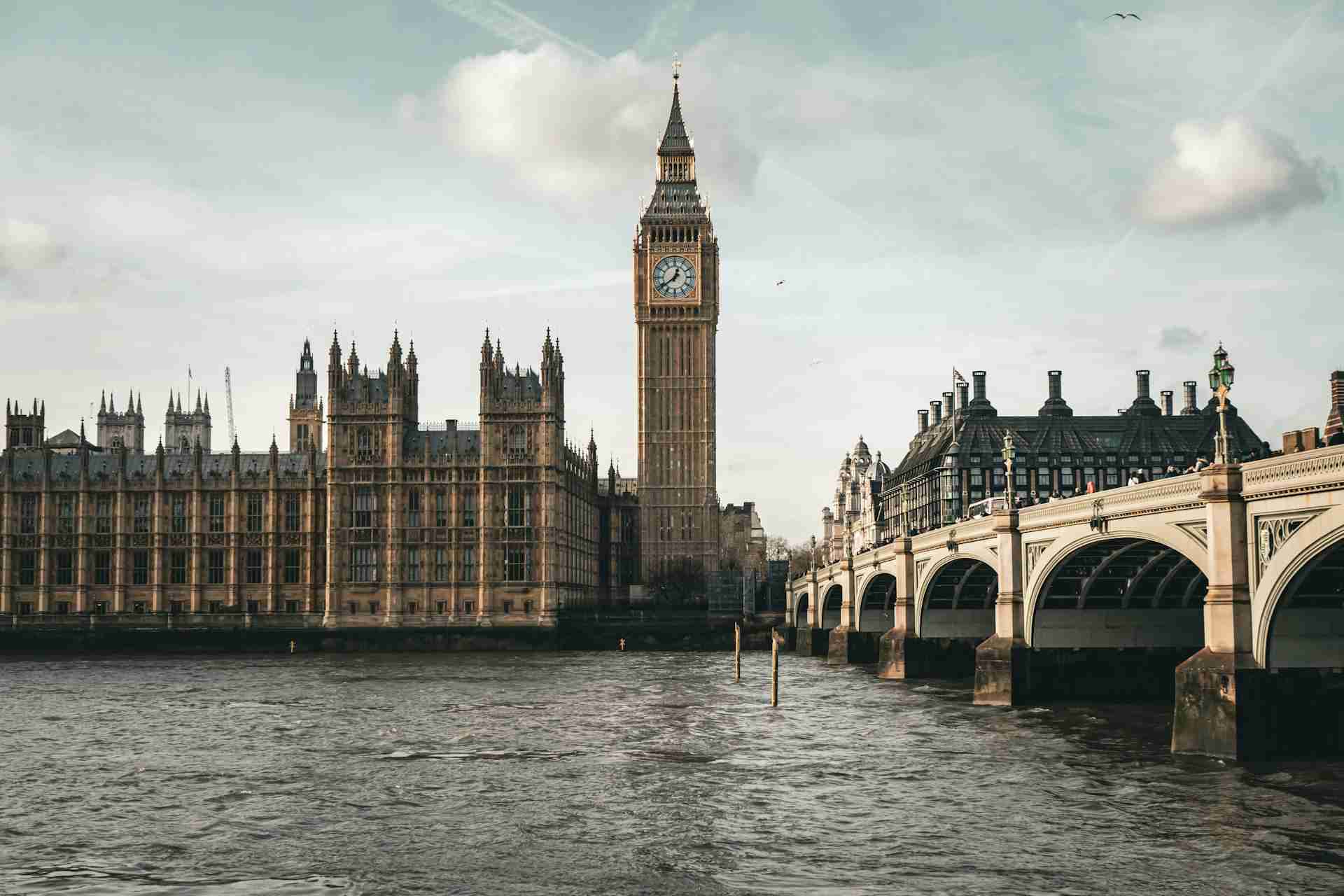
Big Ben, one of London’s most recognisable landmarks, is the nickname for the Great Bell of the Clock at the north end of the Houses of Parliament. The name is often extended to refer to both the clock and the clock tower, officially known as the Elizabeth Tower since 2012, in honour of Queen Elizabeth II’s Diamond Jubilee.
Completed in 1856, the tower stands at 96 metres tall and showcases stunning neo-Gothic architecture. The clock faces, each measuring seven metres in diameter, are renowned for their accuracy and reliability. The intricate mechanism, designed by Edmund Beckett Denison, has kept time for Londoners and visitors for over 160 years.
Big Ben has played a significant role in British culture, chiming through important historical moments. Its distinctive ‘bongs’ mark the hour and have become an audible symbol of London worldwide.
Visitors to London can admire Big Ben from various vantage points around Westminster, with particularly striking views available from the south bank of the Thames. While interior tours are limited, the exterior remains an essential photo opportunity for tourists and a beloved icon for locals.

Big Ben Visitor Information
Admiring Big Ben’s iconic exterior is free and possible from various vantage points across London, including the River Thames. For a more immersive experience, adventurous visitors can book a 90-minute guided tour inside the Elizabeth Tower, home to the famous clock and bell.
This exclusive tour, priced at £30 for adults and £15 for children aged 11-17, allows small groups to ascend 334 spiral steps to the clock mechanism room. Here, visitors can marvel at the intricate workings behind the four clock faces and see the renowned Great Bell up close.
However, the climb is physically demanding and not suitable for those with health conditions affected by sustained exertion. Tickets are limited, with a maximum of eight available per booking, subject to availability.
This unique opportunity offers an unparalleled insight into one of London’s most cherished landmarks, blending history, engineering, and breathtaking views for those willing to make the ascent.
Visit the UK Parliament website for further information and booking options.

How To Get To Big Ben
Big Ben stands at the heart of Westminster, London’s political centre. Its strategic location makes it highly accessible via various transport options.
The most convenient access point is Westminster Underground station, which is directly opposite the tower. Served by the Jubilee, District, and Circle lines, it offers immediate proximity to this iconic landmark.
For those preferring overground travel, numerous bus routes stop near Big Ben, including 11, 12, 24, 26, 87, 88, 148, 453, 734, 786, 788, and 789. These provide flexible options from different parts of the city.
Alternatively, visitors can enjoy a scenic approach via river bus, alighting at Westminster Pier adjacent to the tower. This offers a unique perspective of London’s riverscape.
For those who enjoy a short walk, Waterloo and St James’ Park stations are about 15 minutes away on foot. Charing Cross station, near Trafalgar Square, offers a leisurely 15-20 minute stroll down historic Whitehall, culminating at Big Ben.
Nearby Attractions
Big Ben is situated in the heart of London and is surrounded by numerous attractions within walking distance.
The London Eye
The London Eye, a giant cantilevered observation wheel, stands as an iconic feature of London’s skyline. Located on the South Bank of the River Thames, it offers unparalleled 360-degree views of the capital.
Standing at 135 metres tall, the Eye is Europe’s tallest cantilevered observation wheel. Its 32 sealed and climate-controlled capsules can each accommodate up to 25 passengers, rotating at a leisurely pace that allows for a full revolution in about 30 minutes.
Houses of Parliament
The Houses of Parliament, also known as the Palace of Westminster, is the beating heart of British democracy. This iconic Gothic Revival building, situated on the banks of the River Thames, houses both chambers of the UK Parliament: the House of Commons and the House of Lords.
Dating back to the 11th century, the current structure was largely rebuilt in the 19th century following a devastating fire. Its intricate façade, adorned with statues of monarchs and ornate stonework, is crowned by the famous Clock Tower housing Big Ben.
Visitors can observe parliamentary debates from public galleries when the Houses are in session. Guided tours offer insights into the building’s rich history, architectural splendour, and the workings of the British government. Highlights include Westminster Hall, the oldest part of the complex, and the ornate House of Lords chamber.
10 Downing Street
10 Downing Street, often simply referred to as “Number 10”, is one of the most famous addresses in the world and the official residence and office of the British Prime Minister.
Located in Whitehall, Westminster, this Georgian townhouse has been at the centre of British government for nearly 300 years. Despite its modest façade, the building is deceptively large, containing about 100 rooms and a private residence on the upper floors.
The iconic black door, adorned with the number “10” in brass letters, is one of the most photographed entrances in Britain. It’s guarded round-the-clock by police and is equipped with state-of-the-art security measures.
Behind this door, crucial decisions affecting the UK and often the world are made. The Cabinet Room, where the Prime Minister chairs meetings with senior ministers, has witnessed countless historic moments.
While not open to the public, Number 10 frequently appears in news broadcasts as the backdrop for important announcements. The street itself is closed to public access, but visitors can catch a glimpse of the famous door from the gates at the end of Downing Street.
Trafalgar Square
Trafalgar Square, one of London’s most vibrant public spaces, sits at the heart of the city, commemorating the Battle of Trafalgar of 1805. This iconic square serves as a central hub, connecting several of London’s major thoroughfares.
Dominating the square is Nelson’s Column, a 52-metre tall monument honouring Admiral Horatio Nelson, who died at the Battle of Trafalgar. Four massive bronze lions, designed by Sir Edwin Landseer, guard the base of the column.
The square is flanked by notable buildings, including the National Gallery on its north side, which houses one of the world’s finest collections of Western European paintings. St Martin-in-the-Fields church stands to the northeast, known for its beautiful architecture and regular concert performances.
Trafalgar Square now hosts a variety of events throughout the year, from political demonstrations to cultural celebrations and artistic performances. The Fourth Plinth in the northwest corner of the square showcases changing contemporary art installations, adding a dynamic element to the historic space.
Trafalgar Square remains a popular meeting point and tourist attraction, offering a unique blend of history, art, and contemporary city life. Its central location makes it an ideal starting point for exploring London’s West End and nearby attractions such as Buckingham Palace and Westminster.
Westminster Abbey
Westminster Abbey, located across the road from the Houses of Parliament, is a magnificent Gothic church with over a thousand years of British history. This UNESCO World Heritage site has been the coronation church since 1066 and the final resting place of seventeen monarchs. Its awe-inspiring architecture features soaring vaulted ceilings, intricate stone carvings, and stunning stained-glass windows.
Westminster Cathedral
Westminster Cathedral, not to be confused with Westminster Abbey, is the mother church of the Roman Catholic Church in England and Wales. This striking edifice, located in Victoria, London, stands as a magnificent example of Neo-Byzantine architecture.
Completed in 1903, the cathedral’s distinctive striped brick and stone exterior, coupled with its prominent 83-metre high campanile, creates a stark contrast to London’s predominantly Gothic and classical architectural landscape. The building’s design, by John Francis Bentley, was inspired by early Christian Byzantine churches.
Inside, visitors are greeted by a vast and airy nave, its walls adorned with intricate mosaics that continue to be added to this day. The cathedral’s interior is notable for its marble columns, impressive domes, and side chapels dedicated to various saints.
Buckingham Palace
Buckingham Palace, the official London residence of the British monarch, is an iconic symbol of the British Royal Family and a must-see landmark for visitors to the capital. This grand neo-classical building, with its distinctive cream and gold facade, stands majestically at the end of The Mall in Westminster.
St James’s Park
St James’s Park, the oldest of London’s royal parks, is a tranquil oasis nestled in the heart of Westminster. This 57-acre green space offers a welcome respite from the bustling city, with its lush lawns, flowerbeds, and tree-lined paths.
The park’s centrepiece is a picturesque lake, home to a variety of waterfowl, including the park’s famous pelicans—a tradition dating back to the 17th century when the birds were gifted to Charles II. Visitors can enjoy charming views of Buckingham Palace from the Blue Bridge, which spans the lake.

Hotels Near Big Ben
London’s Westminster area, home to Big Ben, offers a diverse range of accommodation options to suit various preferences and budgets.
For those seeking luxury, several five-star establishments are within walking distance of the iconic clock tower. The London Marriott Hotel, Park Plaza, Corinthia Hotel, The Royal Horseguards, and Raffles London all offer opulent stays with prime locations, allowing guests to immerse themselves in the heart of historic London.
Budget-conscious travellers need not compromise on location. The Premier Inn, situated behind the London Eye, provides affordable comfort. For a more contemporary option, hub by Premier Inn near Westminster Abbey and St James’ Park station offers modern, compact rooms in a central location.
Venturing slightly west towards Victoria Station and Pimlico, visitors will find Belgrave Road. This thoroughfare hosts a variety of hotels catering to all budgets, making it an excellent choice for cost-effective stays without sacrificing accessibility. See Hotels in Pimlico.
Pimlico itself deserves special mention. This charming neighbourhood, often overlooked by tourists, offers a local feel while maintaining excellent transport links. Its proximity to major attractions, coupled with its quieter ambience, makes it an ideal base for exploring London.